Introduction
Choosing a water purifier is not just about comparing brands or prices. The purification technology matters because different systems work in different ways and address different water-quality concerns.
If you are comparing an RO vs UV vs UF water purifier, understanding how each technology works can help you make a more informed decision for your home in Pune.
Reverse osmosis (RO), ultraviolet (UV) treatment and ultrafiltration (UF) use different methods to treat water. RO uses a specialised membrane to reduce many dissolved substances, UV uses ultraviolet light to inactivate susceptible microorganisms, and UF uses a membrane to remove suspended particles and certain microorganisms.
However, no single technology is ideal for every water source. The right choice depends on the water’s quality, its dissolved-solids content, the type of contamination present and the manufacturer’s system specifications.
In this guide, we explain the differences between RO, UV and UF water purifiers, their advantages and limitations, and what households should consider before purchasing a purifier in Pune.
Table of Contents
- What Is an RO Water Purifier?
- What Is a UV Water Purifier?
- What Is a UF Water Purifier?
- RO vs UV vs UF: Key Differences
- Which Water Purifier Is Suitable for Your Water Source?
- Is an RO+UV+UF Water Purifier Necessary?
- Factors to Consider Before Buying a Water Purifier in Pune
- Water Purifier Installation and Maintenance
- Frequently Asked Questions
- Conclusion
1. What Is an RO Water Purifier?
Reverse osmosis, commonly called RO, uses a semipermeable membrane to separate many dissolved substances from water.
RO systems are often considered when water contains elevated dissolved solids or particular contaminants that the selected membrane system is designed to reduce.
How Does RO Work?
Water passes through a membrane under pressure. The membrane allows water to pass while reducing many dissolved substances. The system separates a portion of the incoming water as reject water, which varies with the purifier design and operating conditions.
Benefits of RO Purification
- Can reduce many dissolved salts and other substances, depending on the membrane and system.
- Can be suitable for certain water sources with elevated total dissolved solids (TDS).
- May form part of a multi-stage purification system.
- Can address specific water-quality concerns when the system is appropriately selected.
Limitations of RO
RO systems generally require adequate operating pressure and may use more water than the volume of purified water produced. They can also reduce some minerals along with unwanted dissolved substances.
An RO purifier should not be selected solely because it is a popular product. Water quality should guide the decision.
2. What Is a UV Water Purifier?
A UV water purifier uses ultraviolet light to inactivate susceptible microorganisms, including certain bacteria and viruses, when the system is designed and operated correctly.
Unlike RO, UV treatment does not remove dissolved salts from water.
Benefits of UV Purification
- Does not rely on a membrane to reduce dissolved salts.
- Can inactivate susceptible microorganisms under suitable operating conditions.
- Does not normally add treatment chemicals to the water.
- Can be used alongside other filtration technologies.
Limitations of UV
UV treatment does not remove dissolved solids, and its effectiveness depends on factors such as UV intensity, exposure time, water clarity and system maintenance.
Water with excessive turbidity or particles may need appropriate pre-treatment. A UV system also does not automatically address every possible chemical contaminant.
UV treatment is therefore best considered according to the actual water-quality concern rather than as a universal solution.
3. What Is a UF Water Purifier?
Ultrafiltration (UF) uses a membrane with very small pores to separate suspended particles and certain microorganisms from water.
UF membranes generally do not remove dissolved salts in the way an RO membrane does.
Benefits of UF Purification
- Can reduce suspended particles and certain microorganisms.
- Does not require RO-style pressure-driven desalination.
- Typically produces no RO reject-water stream as part of the UF membrane process itself.
- May be useful when the main treatment requirement involves particles and specific microorganisms.
Limitations of UF
UF does not generally reduce dissolved salts or TDS significantly. Its effectiveness depends on the membrane specifications, water conditions and overall system design.
UF alone should not be assumed to make microbiologically unsafe water safe under every condition. The suitability of a system depends on the contaminants present and the treatment performance verified for that system.
4. RO vs UV vs UF: Key Differences
The following table summarises the main differences between the three technologies.
| Feature | RO | UV | UF |
|---|---|---|---|
| Main mechanism | Semipermeable membrane | Ultraviolet light | Ultrafiltration membrane |
| Reduces many dissolved salts | Yes, depending on system | No | Generally no |
| Inactivates susceptible microorganisms | Depends on the complete system | Yes, under suitable conditions | Removes certain microorganisms by physical separation |
| Removes suspended particles | Depends on pre-filters and system design | No, not by UV treatment itself | Yes, within membrane specifications |
| Produces RO reject water | Generally yes | No RO reject stream | No RO reject stream from UF membrane treatment itself |
| Requires electricity | Depends on system; most domestic RO units use electricity | Yes | Depends on the complete purifier design |
| Best selected according to | Dissolved substances and other specified contaminants | Microbiological treatment requirements | Suspended particles and specified microorganisms |
Important: These are general technology-level comparisons. A complete purifier may combine several treatment stages, and its actual performance depends on its design, certification, maintenance and operating conditions.
5. Which Water Purifier Is Suitable for Your Water Source?
The best purifier depends on the characteristics of your incoming water. Do not choose a system based on a neighbour’s recommendation alone, because two homes in the same locality may receive water from different sources.
When RO May Be Appropriate
An RO system may be appropriate when testing identifies elevated dissolved solids or specific dissolved contaminants that the chosen system is designed to reduce.
Before purchasing, check the purifier’s documented reduction performance and water recovery characteristics.
When UV May Be Appropriate
UV treatment may be useful when microbial inactivation is required and the incoming water is otherwise suitable for the system.
If dissolved salts or certain chemical contaminants are also a concern, UV alone will not address them.
When UF May Be Appropriate
UF may be suitable for water requiring removal of suspended particles and certain microorganisms, provided the system is appropriate for the source water and the relevant risks are addressed.
What About Municipal and Borewell Water in Pune?
Water supplied to homes in Pune can vary according to its source, treatment and distribution conditions. Some properties use municipal supplies, while others may depend on borewell water, tanker deliveries or a combination.
Do not assume that every municipal supply requires RO or that every borewell supply needs the same purifier.
Where possible, obtain a reliable water-quality assessment. Testing can help identify concerns involving dissolved solids, microbial contamination or other parameters and guide the selection of a suitable treatment system.
6. Is an RO+UV+UF Water Purifier Necessary?
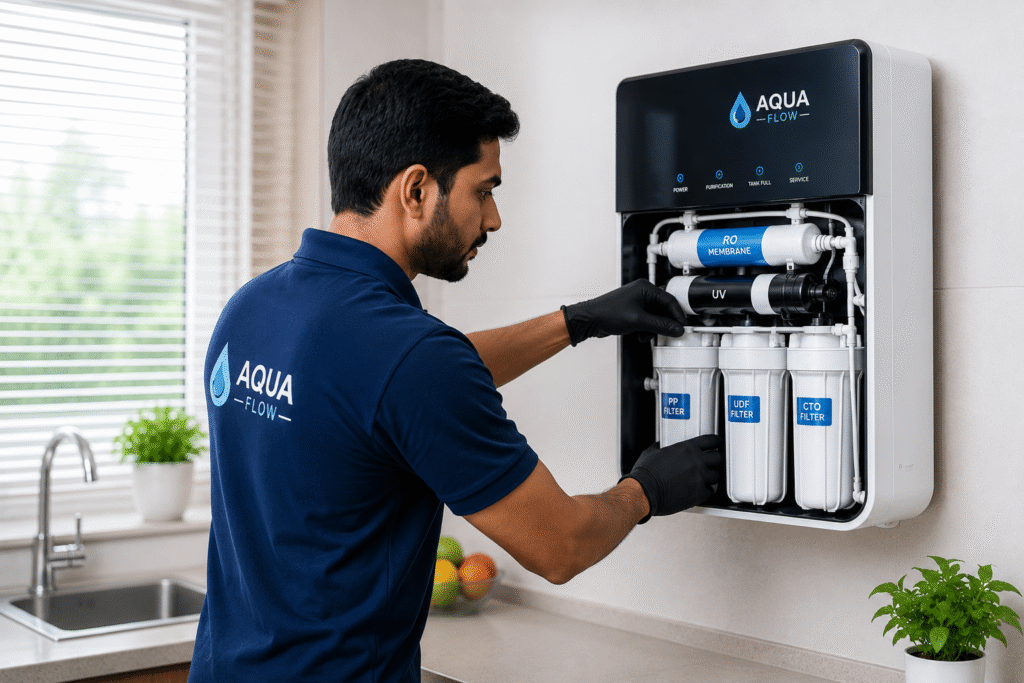
Some domestic purifiers combine RO, UV and UF technologies with sediment and carbon filtration.
A multi-stage system can address different treatment requirements, but more technologies do not automatically mean better water purification for every home.
For example, a home whose water requires treatment for specific dissolved contaminants may need a different system from one whose main concern is microbial contamination.
Before selecting an RO+UV+UF purifier, consider:
- The results of a water-quality assessment.
- The contaminants the system is designed to reduce.
- The manufacturer’s documented performance.
- Water recovery and reject-water requirements.
- Replacement-filter costs and maintenance needs.
- Availability of compatible parts and service support.
Choose a system that addresses the actual water-quality concerns rather than paying for features that may not be necessary.
7. Factors to Consider Before Buying a Water Purifier in Pune
Test Your Water Quality
Water testing is an important starting point. TDS measurements can provide useful information about dissolved substances, but TDS alone does not identify every contaminant or confirm that water is microbiologically safe.
Compare Purification Performance
Check the manufacturer’s documentation for the specific contaminants reduced, system limitations and maintenance requirements.
Avoid relying solely on broad claims such as “removes all impurities.”
Consider Daily Water Consumption
Household size and daily demand affect the storage capacity and output requirements of a purifier. Choose a system that meets your household’s needs without unnecessary complexity.
Check Maintenance Costs
The purchase price is only one part of ownership. Consider filter replacement, membrane replacement where applicable, servicing and electricity requirements.
Check Local Service Availability
Before buying, consider whether suitable maintenance and compatible replacement parts are available for your purifier model in Pune.
Aqua Flow provides water purifier service enquiries for repair, installation, filter replacement and maintenance. Visit the Aqua Flow water purifier service page to explore its listed services.
8. Water Purifier Installation and Maintenance
Even an appropriately selected purifier needs correct installation and regular maintenance.
Professional Installation
Installation requirements vary by purifier type and model. Correct placement, water connections, drainage where required and the manufacturer’s instructions all matter.
If you need installation assistance, visit the water purifier installation page for Pune.
Filter and Membrane Maintenance
Replacement schedules depend on the specific purifier, incoming water quality, usage and manufacturer recommendations. Replacing components too early can increase expenses, while delaying necessary maintenance can affect performance.
Recognising Performance Changes
Changes in water flow, leakage, unusual noise or other operating symptoms may indicate that an inspection is needed.
For purifier repair enquiries, explore RO repair near you in Pune.
9. Frequently Asked Questions
1. Which is better: RO, UV or UF?
None is universally best. RO can reduce many dissolved substances, UV can inactivate susceptible microorganisms, and UF can remove suspended particles and certain microorganisms. The right choice depends on the water source and treatment requirements.
2. Does UV purification reduce TDS?
No. UV treatment inactivates susceptible microorganisms but does not remove dissolved salts or significantly reduce TDS.
3. Does UF remove dissolved salts?
UF generally does not remove dissolved salts in the way an RO membrane does. Its main function is separating suspended particles and certain microorganisms.
4. Is RO necessary for municipal water in Pune?
Not necessarily. The appropriate technology depends on the actual water quality and contaminants present. Test the water where possible instead of selecting RO based only on the source label.
5. Is an RO+UV+UF purifier always better than an RO purifier?
Not automatically. Additional treatment stages may be useful when they address specific water-quality requirements, but suitability depends on the complete system and the incoming water.
6. Does RO purification waste water?
Domestic RO systems generally produce a reject-water stream during purification. The amount varies with system design, incoming water quality, pressure and operating conditions.
7. How often should water purifier filters be changed?
Follow the manufacturer’s recommended schedule and consider actual operating conditions. Replacement intervals differ between filter types, purifier models and water sources.
8. Where can I get water purifier installation or service in Pune?
You can contact Aqua Flow to enquire about installation, repair, filter replacement and maintenance. Confirm service availability for your address and purifier model before booking.
Conclusion
Understanding the difference between RO, UV and UF water purifiers helps you make a more informed decision about household water treatment.
RO can reduce many dissolved substances, UV can inactivate susceptible microorganisms, and UF can remove suspended particles and certain microorganisms. Each technology has limitations, so the best option depends on your water source, test results and treatment requirements.
For homes in Pune, start by understanding the quality of your incoming water, comparing documented purifier performance and considering long-term maintenance costs.
If you need help with purifier installation, repair or maintenance, contact Aqua Flow at +91 92099 90623 to enquire about service availability.